
Show your support by donating any amount. (Note: We are still technically a for-profit company, so your
contribution is not tax-deductible.)
PayPal Acct:  Feedback:
Donate to VoyForums (PayPal):
| [ Login ] [ Contact Forum Admin ] [ Main index ] [ Post a new message ] [ Search | Check update time | Archives: 1, [2], 3, 4, 5, 6, 7, 8, 9, 10 ] |
Parallel Strata
Earth’s sedimentary layers are typically parallel to adjacent layers. Such uniform layers are seen, for example, in the Grand Canyon and in road cuts in mountainous terrain. Had these parallel layers been deposited slowly over thousands of years, erosion would have cut many channels in the topmost layers. Their later burial by other sediments would produce nonparallel patterns. Because parallel layers are the general rule, and the earth’s surface erodes rapidly, one can conclude that almost all sedimentary layers were deposited rapidly relative to the local erosion rate—not over long periods of time (The mechanism involved is explained on pages 195-211 ).
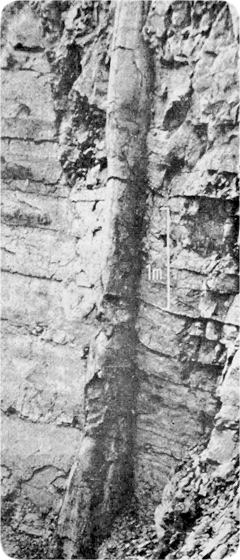
Figure 11: Polystrate Fossil. Fossils crossing two or more sedimentary layers (strata) are called poly- (many) strate (strata) fossils. Consider how quickly this tree trunk in Germany must have been buried. Had burial been slow, the tree top would have decayed. Obviously, the tree could not have grown up through the strata without sunlight and air. The only alternative is rapid burial. Some polystrate trees are upside down, which could occur in a large flood. Soon after Mount St. Helens erupted in 1980, scientists saw trees being buried in a similar way in the lake-bottom sediments of Spirit Lake. Polystrate tree trunks are found worldwide. (Notice the 1-meter scale bar, equal to 3.28 feet, in the center of the picture.)
[From “In the Beginning” by Walt Brown ]
[
Next Thread |
Previous Thread |
Next Message |
Previous Message
]
|
Forum timezone: GMT-8 VF Version: 3.00b, ConfDB: Before posting please read our privacy policy. VoyForums(tm) is a Free Service from Voyager Info-Systems. Copyright © 1998-2019 Voyager Info-Systems. All Rights Reserved. |