
Show your support by donating any amount. (Note: We are still technically a for-profit company, so your
contribution is not tax-deductible.)
PayPal Acct:  Feedback:
Donate to VoyForums (PayPal):
| [ Login ] [ Contact Forum Admin ] [ Main index ] [ Post a new message ] [ Search | Check update time | Archives: 1, 2, 3, [4], 5, 6, 7, 8, 9, 10 ] |
Estimated old ages for the Earth are frequently based on “clocks” that today are ticking at extremely slow rates. For example, coral growth rates were thought to have always been very slow, implying that some coral reefs must be hundreds of thousands of years old. More accurate measurements of these rates under favorable growth conditions now show that no known coral formation need be older than 3,400 years (a). A similar comment can be made for growth rates of stalactites and stalagmites in caves (b). [See figure 145 here]
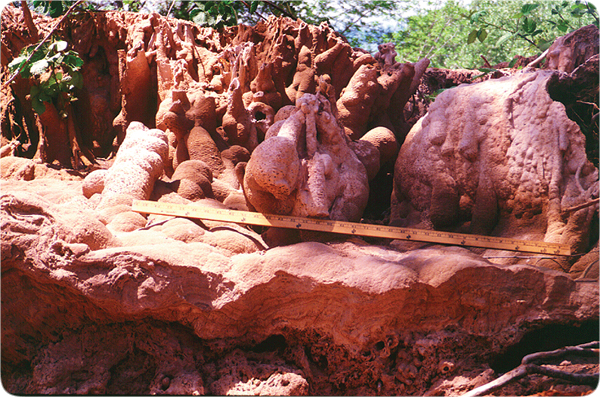
Figure 28: Stalagmites. Water from an underground spring was channeled to this spot on a river bank for only one year. In that time, limestone built up around sticks lying on the bank. Limestone deposits can form rapidly if the groundwater’s chemistry is favorable. Just because stalactites and stalagmites are growing slowly today does not mean they must be millions of years old. As we will see in Part II, conditions after the flood provided the ideal chemistry for rapidly forming such features.
a. Ariel A. Roth, “Coral Reef Growth,” Origins, Vol. 6, No. 2, 1979, pp. 88–95.
J. Th. Verstelle, “The Growth Rate at Various Depths of Coral Reefs in the Dutch East Indian Archipelago,” Treubia, Vol. 14, 1932, pp. 117–126.
b. Ian T. Taylor, In the Minds of Men (Toronto: TFE Publishing, 1984), pp. 335–336.
Larry S. Helmick, Joseph Rohde, and Amy Ross, “Rapid Growth of Dripstone Observed,” Creation Research Society Quarterly, Vol. 14, June 1977, pp. 13–17.
[From “In the Beginning” by Walt Brown ]
[
Next Thread |
Previous Thread |
Next Message |
Previous Message
]
|
Forum timezone: GMT-8 VF Version: 3.00b, ConfDB: Before posting please read our privacy policy. VoyForums(tm) is a Free Service from Voyager Info-Systems. Copyright © 1998-2019 Voyager Info-Systems. All Rights Reserved. |