
Show your support by donating any amount. (Note: We are still technically a for-profit company, so your
contribution is not tax-deductible.)
PayPal Acct:  Feedback:
Donate to VoyForums (PayPal):
| [ Login ] [ Contact Forum Admin ] [ Main index ] [ Post a new message ] [ Search | Check update time | Archives: 1, 2, 3, 4, [5], 6, 7, 8, 9, 10 ] |
Strange Planets 3
Is Pluto a Planet?
In 2006, after years of internal debate, 4% of the members of the International Astronomical Union (IAU)—those meeting in Prague—voted to no longer call Pluto a planet. Instead, they said Pluto is a trans-neptunian object (h).
The IAU had no jurisdiction to change the definition of “planet” for the rest of the world. It is fine for an organization to tell others what it considers a word to mean, but common usage is the basis for definitions. Our language is filled with scientific words whose meanings have changed based on new discoveries and broader understandings. Few meanings have changed based on an organization’s vote.
Since Pluto’s discovery 76 years earlier, Pluto has been a thorn in the side of astronomers trying to explain how planets evolve (i), because so many characteristics of Pluto do not fit into evolutionary scenarios. No longer calling Pluto a planet (even though it is spherical, has three known moons, and orbits the Sun in the right direction) may reduce those man-made problems, but now calls attention to the more difficult question of how a thousand trans-neptunian objects evolved.
In 1930, after astronomers had been searching for a suspected ninth planet for 25 years, a tenacious farm boy from Kansas, Clyde W. Tombaugh (1906–1997), discovered Pluto at Lowell Observatory in Flagstaff, Arizona. He later became one of my favorite professors. Going to his backyard to use his handmade 9-inch telescope was memorable. Professor Tombaugh was a warm, unpretentious man with the biggest smile you have ever seen. However, in class, he sometimes became irate at astronomers who made pronouncements but seldom touched a telescope.
Classification can be a useful tool, but at other times it leads to endless arguments, because the world (or, in this case, the solar system) is usually more complicated than theories imply. We can call Pluto anything we wish, but tens of thousands of books and hundreds of millions of students have called Pluto a planet.
What is a planet? Its original meaning was “wandering star.” I will always associate Pluto with Clyde Tombaugh and the worldwide excitement of finally discovering the ninth planet. For historical reasons, if nothing else, I suspect that millions of others will continue to call Pluto a planet as well as a trans-neptunian object.
Semantics aside, the scientific question remains: how could Pluto evolve?
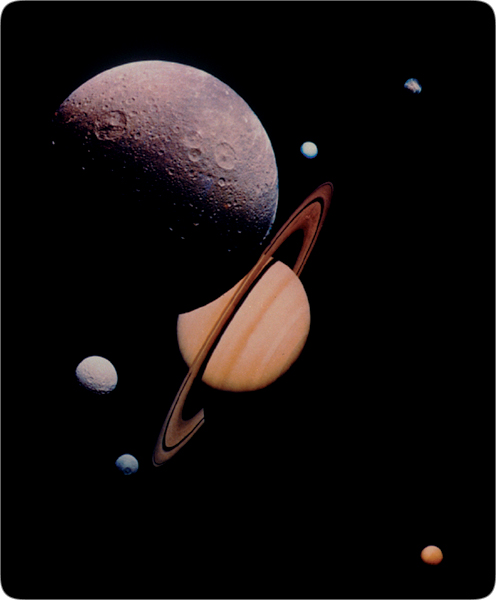
Figure 23: Saturn and Six of Its Moons. Saturn has 60 known moons. One of them, named Phoebe, has an orbit almost perpendicular to Saturn’s equator. This is difficult for evolutionist astronomers to explain.
h. All those astronomers and planetary scientists said,
We, as planetary scientists and astronomers, do not agree with the IAU’s definition of a planet, nor will we use it. Jenny Hogan, “Pluto: The Backlash Begins,” Nature, Vol. 442, 31 August 2006, pp. 965.
A trans-Neptunian object (TNO) is any minor planet orbiting the Sun at a greater average distance than Neptune.
Contributing to the IAU’s decision to remove Pluto’s status as a planet was its small size (two-thirds the diameter of our moon) and the discovery, beginning in 1992, of thousands of trans-Neptunian objects, at least two of which are larger than Pluto. All are much farther from the Sun than Pluto.
The stated reason for the IAU’s decision to remove Pluto’s status as a planet was its small size (two-thirds the diameter of our moon) and the discovery, beginning in 1992, of thousands of trans-Neptunian objects, at least two of which are larger than Pluto but much farther from the Sun than Pluto. The unstated reason for the IAU’s decision was that Pluto, since its discovery in 1930, contradicted evolutionary theories for how planets evolve. Pluto was a thorn in the evolutionists’ side.
A simple fix for the IAU would have been to consider Pluto as both a trans-Neptunian objects and (for historical reasons) a planet. Also, an honest acknowledgement that all planets are unique would have clarified matters. Hundreds of planets discovered outside the solar system are completely different from those inside the solar system. Evolutionary processes do not explain them. [See "Have Planets Been Discovered Outside the Solar System?” http://www.creationscience.com/onlinebook/FAQ23.html#wp5215740]
For more information on the battles among astronomers concerning Pluto’s planetary status, see Laurence A. Marschall and Stephen P. Maran, Pluto Confidential (Dallas, Texas: Benbella Books, Inc., 2009). Thousands of professional astronomers will not abide by the IAU’s stealthy vote and will continue to consider Pluto a planet.
i. “Pluto has long been a misfit in the prevailing theories of the solar system’s origin: it is thousands of times less massive than the four gas-giant outer planets, and its orbit is very different from the well-separated, nearly circular and co-planar orbits of the eight other major planets. Pluto’s is eccentric: during one complete revolution, the planet’s distance from the sun varies from 29.7 to 49.5 astronomical units [AU] .... Pluto also travels 8 AU above and 13 AU below the mean plane of the other planets’ orbits.” Renu Malhotra, “Migrating Planets,” Scientific American, Vol 281, September 1999, p. 59.
[From “In the Beginning” by Walt Brown ]
[
Next Thread |
Previous Thread |
Next Message |
Previous Message
]
|
Forum timezone: GMT-8 VF Version: 3.00b, ConfDB: Before posting please read our privacy policy. VoyForums(tm) is a Free Service from Voyager Info-Systems. Copyright © 1998-2019 Voyager Info-Systems. All Rights Reserved. |