
Show your support by donating any amount. (Note: We are still technically a for-profit company, so your
contribution is not tax-deductible.)
PayPal Acct:  Feedback:
Donate to VoyForums (PayPal):
| [ Login ] [ Contact Forum Admin ] [ Main index ] [ Post a new message ] [ Search | Check update time | Archives: 1, 2, 3, 4, [5], 6, 7, 8, 9, 10 ] |
Venus must have a strong crust to support its extremely high, dense (a) mountains. One mountain, Maat Mons, rises higher than Earth’s Mount Everest does above sea level. Because Venus is relatively near the Sun, its atmosphere is 860°F—so hot its surface rocks must be weak or “tarlike.” (Lead melts at 622°F and zinc at 787°F.) Only if Venus’ subsurface rocks are cold and strong can its mountains defy gravity. This allows us to draw two conclusions, both of which contradict major evolutionary assumptions.
First, evolutionists assume that planets grew (evolved) by the gradual accumulation of rocky debris falling in from outer space, a process called gravitational accretion. Heat generated by a planet’s worth of impacts would have left the rocky planets molten. However, Venus was never molten. Had it been, its hot atmosphere would have prevented its subsurface rocks from cooling enough to support its mountains. So, Venus did not evolve by gravitational accretion.
Secondly, evolutionists believe the entire solar system is billions of years old. If Venus were billions of years old, its atmospheric heat would have “soaked” deeply enough into the planet to weaken its subsurface rocks. If so, not only could Venus’ crust not support mountains, the hot mountains themselves could not maintain their steep slopes. Venus must be relatively young.
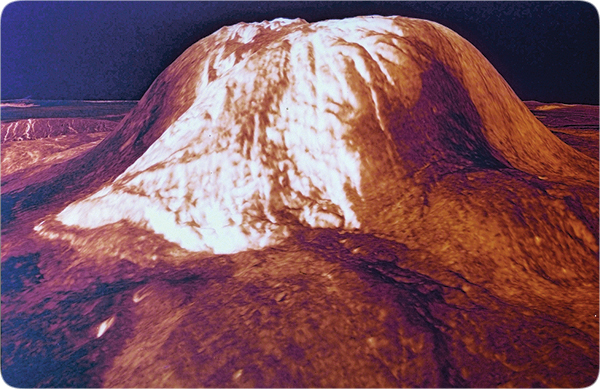
Figure 25: Maat Mons on Venus. If Venus’ mountains were composed of lighter material, they would “float” in the denser rock below, similar to an iceberg floating in denser liquid water. (Mountains on Earth are buoyed up, because they have a density of about 2.7 gm/cm3 and “float” in rock that is about 3.3 gm/cm3.) Data from the Magellan spacecraft that orbited and mapped Venus for several years showed that Venus’ mountains are composed of rock that is too dense to “float.” So, what supports them? It must be Venus’ strong crust—despite Venus’ extremely hot atmosphere. This implies Venus is not old and did not evolve.
(a) Richard A. Kerr, “A New Portrait of Venus: Thick-Skinned and Decrepit,” Science, Vol. 263, 11 February 1994, pp. 759–760.
[From “In the Beginning” by Walt Brown ]
[
Next Thread |
Previous Thread |
Next Message |
Previous Message
]
|
Forum timezone: GMT-8 VF Version: 3.00b, ConfDB: Before posting please read our privacy policy. VoyForums(tm) is a Free Service from Voyager Info-Systems. Copyright © 1998-2019 Voyager Info-Systems. All Rights Reserved. |