
Show your support by donating any amount. (Note: We are still technically a for-profit company, so your
contribution is not tax-deductible.)
PayPal Acct:  Feedback:
Donate to VoyForums (PayPal):
| [ Login ] [ Contact Forum Admin ] [ Main index ] [ Post a new message ] [ Search | Check update time | Archives: 1, 2, 3, 4, 5, 6, 7, [8], 9, 10 ] |
Photographs taken from Earth-orbiting satellites show small, ice-filled comets striking Earth’s upper atmosphere at an average rate of one every three seconds (a).
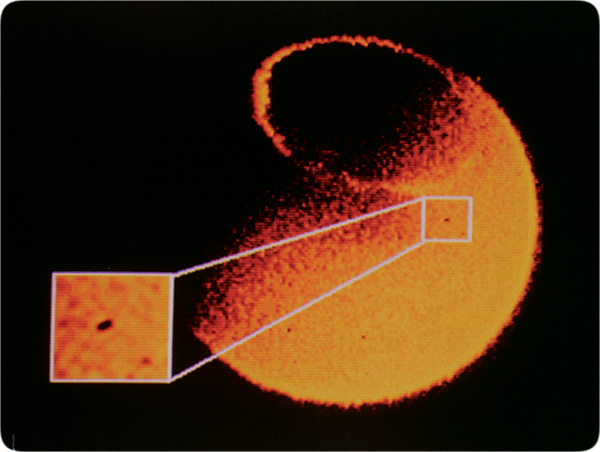
Figure 33: Small Comets. The Dynamic Explorer satellite took this picture in ultraviolet light showing small comets (the dark spots) colliding with Earth’s upper atmosphere. The comets begin to break up 800 miles above the Earth’s surface, then frictional heating vaporizes the pieces and their descent stops at an elevation of about 35 miles. The water vapor, which soon dissipates, blocks ultraviolet light from Earth, producing the dark spots. The northern lights are shown by the halo.
Each comet adds 20–40 tons of water to the Earth’s atmosphere. If this influx began when evolutionists say the Earth started to evolve, all our oceans would have come from small comets. Actually, impact rates were undoubtedly greater in the past, because the planets have swept many of these comets from the solar system. Therefore, small comets would have placed much more water on Earth than is here today. Obviously, this did not happen, so oceans look young. [See also pages 287 and 295]
a. Louis A. Frank with Patrick Huyghe, The Big Splash (New York: Carol Publishing Group, 1990).
Richard Monastersky, “Comet Controversy Caught on Film,” Science News, Vol. 133, 28 May 1988, p. 340.
Timothy M. Beardsley, “Ice Storm,” Scientific American, Vol. 258, June 1988, p. 24.
Jonathan Eberhart, “A Bunch of Little Comets—But Just a Little Bunch,” Science News, Vol. 132, 29 August 1987, p. 132.
Richard A. Kerr, “In Search of Elusive Little Comets,” Science, Vol. 240, 10 June 1988, pp. 1403–1404.
Richard A. Kerr, “Double Exposures Reveal Mini-Comets?” Science, Vol. 243, 13 January 1989, pp. 170–171.
Richard Monastersky, “Small Comet Controversy Flares Again,” Science News, Vol. 137, 9 June 1990, p. 365.
For the last 150 years, the age of the Earth, as assumed by evolutionists, has been doubling at roughly a rate of once every 15 years. In fact, since 1900 this age has multiplied by a factor of 100!
Actually, most dating techniques indicate that the Earth and solar system are young—possibly less than 10,000 years old.
[From “In the Beginning” by Walt Brown]
[
Next Thread |
Previous Thread |
Next Message |
Previous Message
]
|
Forum timezone: GMT-8 VF Version: 3.00b, ConfDB: Before posting please read our privacy policy. VoyForums(tm) is a Free Service from Voyager Info-Systems. Copyright © 1998-2019 Voyager Info-Systems. All Rights Reserved. |