Author:
Interesting facts:precipitation covers only about 2% to 5% of the surface of the Earth, while evaporation is occurring over the remaining 95% to 98% of the Earth. Thus, water vapor gets "concentrated" into relatively small rain systems that turn this vapor into precipitation.
|
[
Next Thread |
Previous Thread |
Next Message |
Previous Message
]
Date Posted: 26/11/10 11:09:51
In reply to:
RAINING State Election Wall Street Close Early 5am==1pm New York===Saturday 27/11/2010===Black Friday
's message, " " on 26/11/10 10:57:32 " on 26/11/10 10:57:32
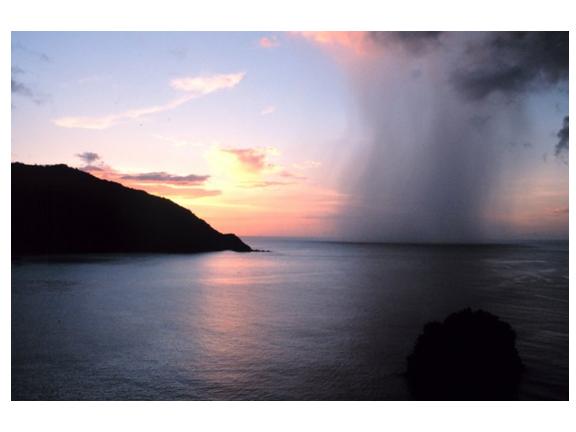
Precipitation forms when cloud droplets (or ice particles) in clouds grow and combine to become so large that the updrafts in the clouds can no longer support them, and they fall to the ground. The more water vapor there is below the cloud, and the stronger the updrafts that cause this water vapor to condense into cloud water or ice particles, the more likely it is that precipitation will form within the cloud. A cloudy day with no precipitation indicates that there is either not enough water vapor available to the cloud, or that the rising motion creating the cloud is not enough to cause precipitation (or both). At the opposite extreme is a tropical rain shower that has large amounts of water vapor available to it (like the one pictured above), and which can rain heavily from even a small cloud.
Interesting facts:
PRECIPITATION EQUALS EVAPORATION All of the precipitation that falls originated as water vapor that was evaporated from the surface of the Earth. It is always raining somewhere on the Earth, just as evaporation is always occurring over most of the Earth's surface. At any given time, precipitation covers only about 2% to 5% of the surface of the Earth, while evaporation is occurring over the remaining 95% to 98% of the Earth. Thus, water vapor gets "concentrated" into relatively small rain systems that turn this vapor into precipitation.
[
Next Thread |
Previous Thread |
Next Message |
Previous Message
]
|

 Feedback: